
The complete guide
How to Choose a 48 Inch Round Fire Pit Cover That Lasts
The problem nobody thinks about until it is too late
Buying a fire pit is the fun part. You picture autumn evenings, a drink, people pulling their chairs in closer. What nobody pictures is the April morning when you lift the lid and find three inches of brown water, a mat of wet leaves, and a burner that will not light because the ports are clogged with grit.
That is the normal life of an uncovered fire pit. It does not fail dramatically. It just degrades. Rain gets into the bowl and sits there. Lava rock and fire glass turn cloudy with dust and algae. Steel rusts at the welds. On gas models, the burner tube and igniter take the worst of it, and those are the expensive parts to replace.
A cover stops nearly all of that for a fraction of what the pit itself cost. It is one of the clearest value-for-money upgrades in outdoor living, which is probably why people who are shopping for the best fire pit cover tend to buy one and then wonder why they waited.
What this cover actually is
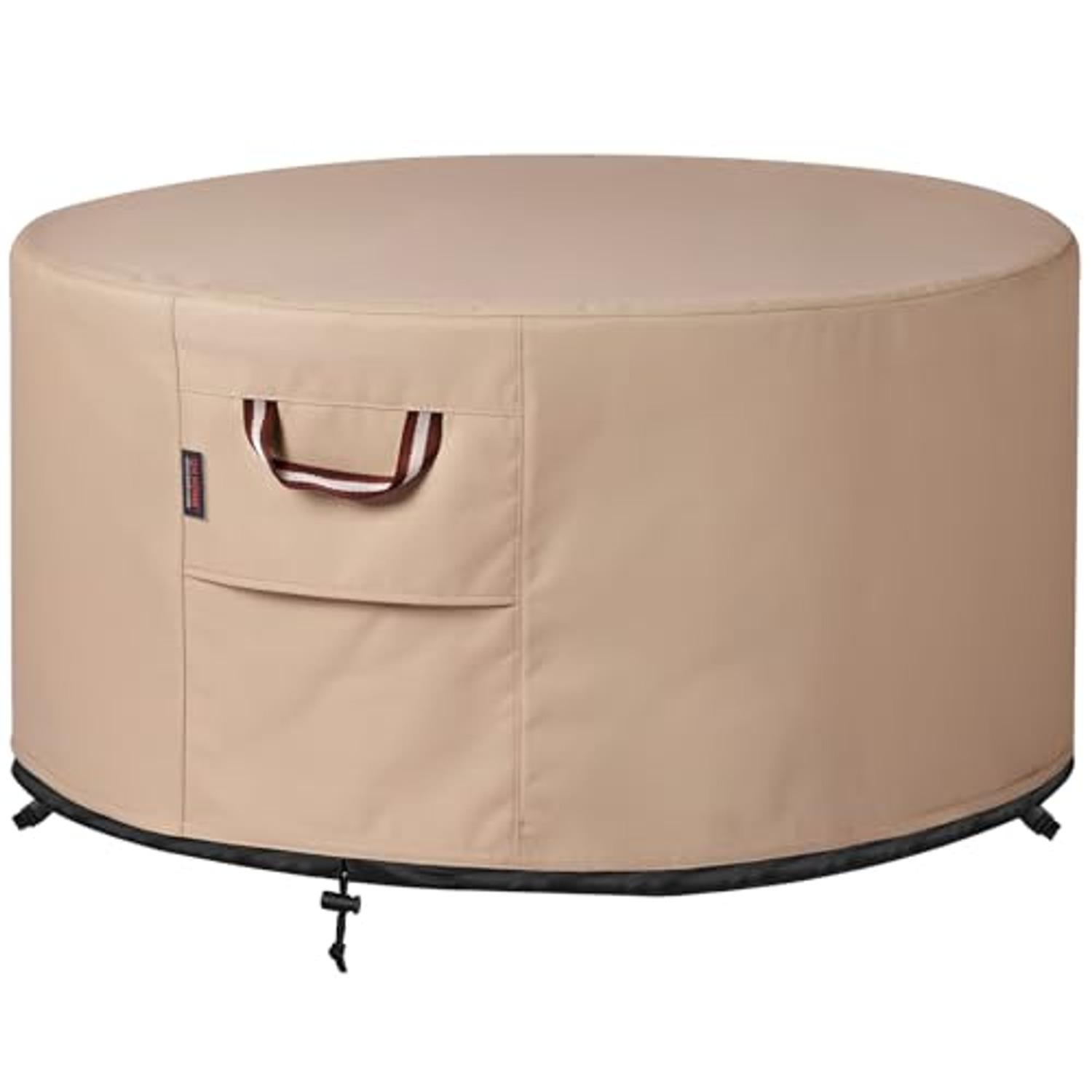
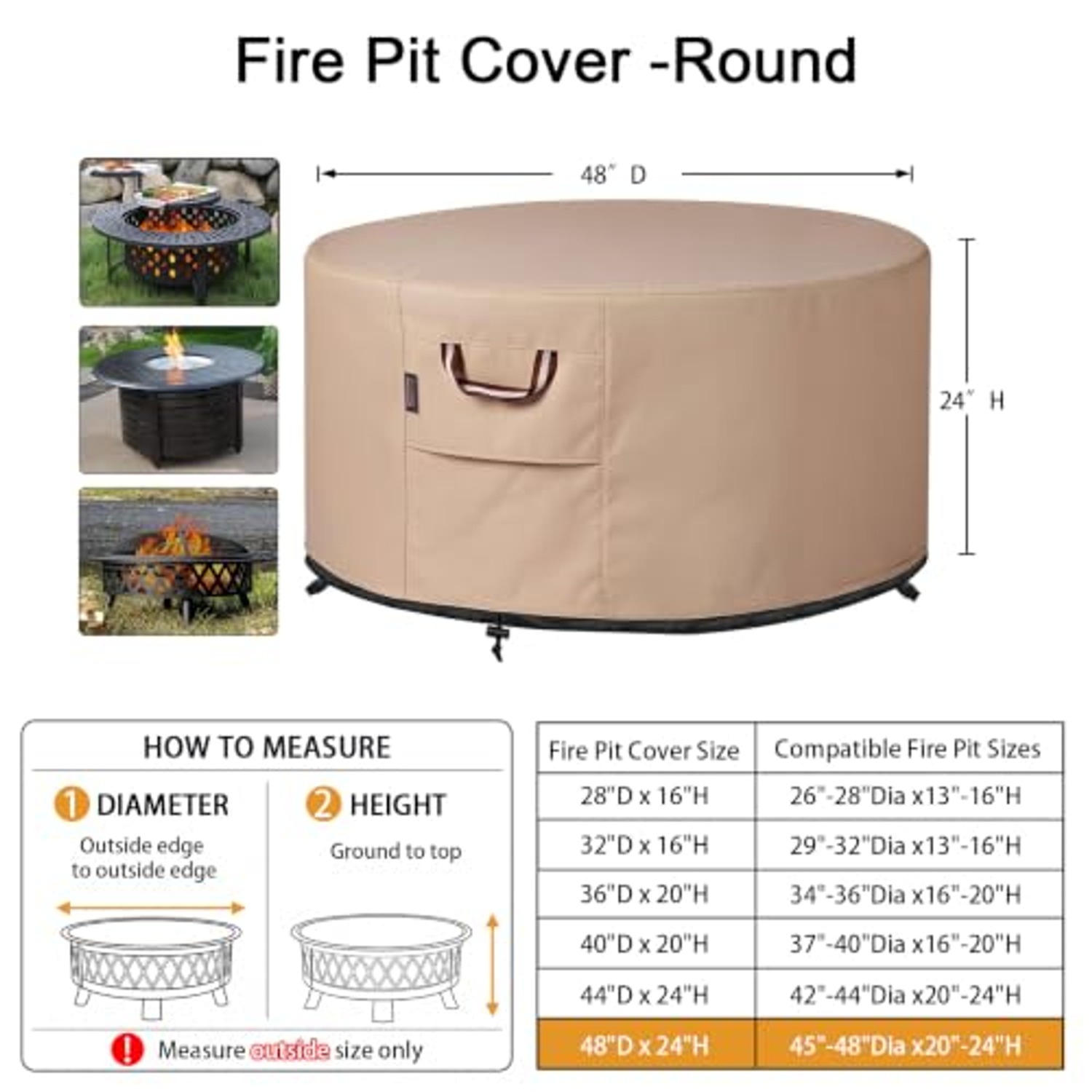
This is a round cover built for fire pits and fire pit tables measuring 45 to 48 in across the top and standing 23 to 25 in high. The cover itself is 24 in tall, which means the fabric does not just sit on the surface like a lid. It drops down past the rim and covers the sides.
That depth matters more than people expect. Rain rarely falls straight down in open weather. It comes in at an angle, driven by wind, and a shallow cover leaves the whole side of the pit exposed to it. Full-height coverage is the difference between a dry burner and a damp one.
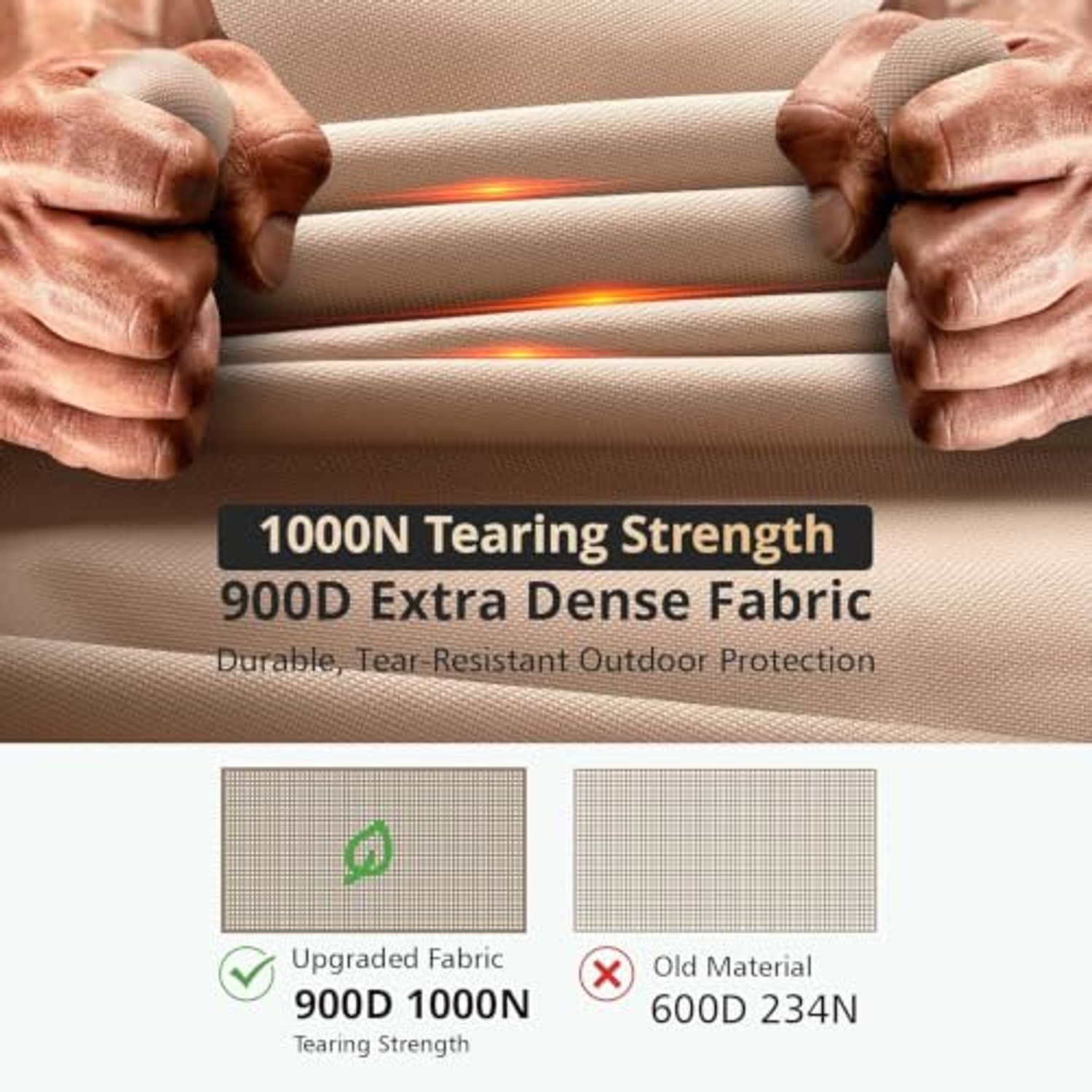
The fabric is 900D Oxford polyester with a PVC coating. The color is wheat, a light tan that does not show dust the way black does.
Understanding the fabric numbers
You will see denier ratings everywhere in this category, written as 210D, 420D, 600D and 900D. Denier is simply a measure of yarn thickness. Higher number, thicker thread, tougher fabric.
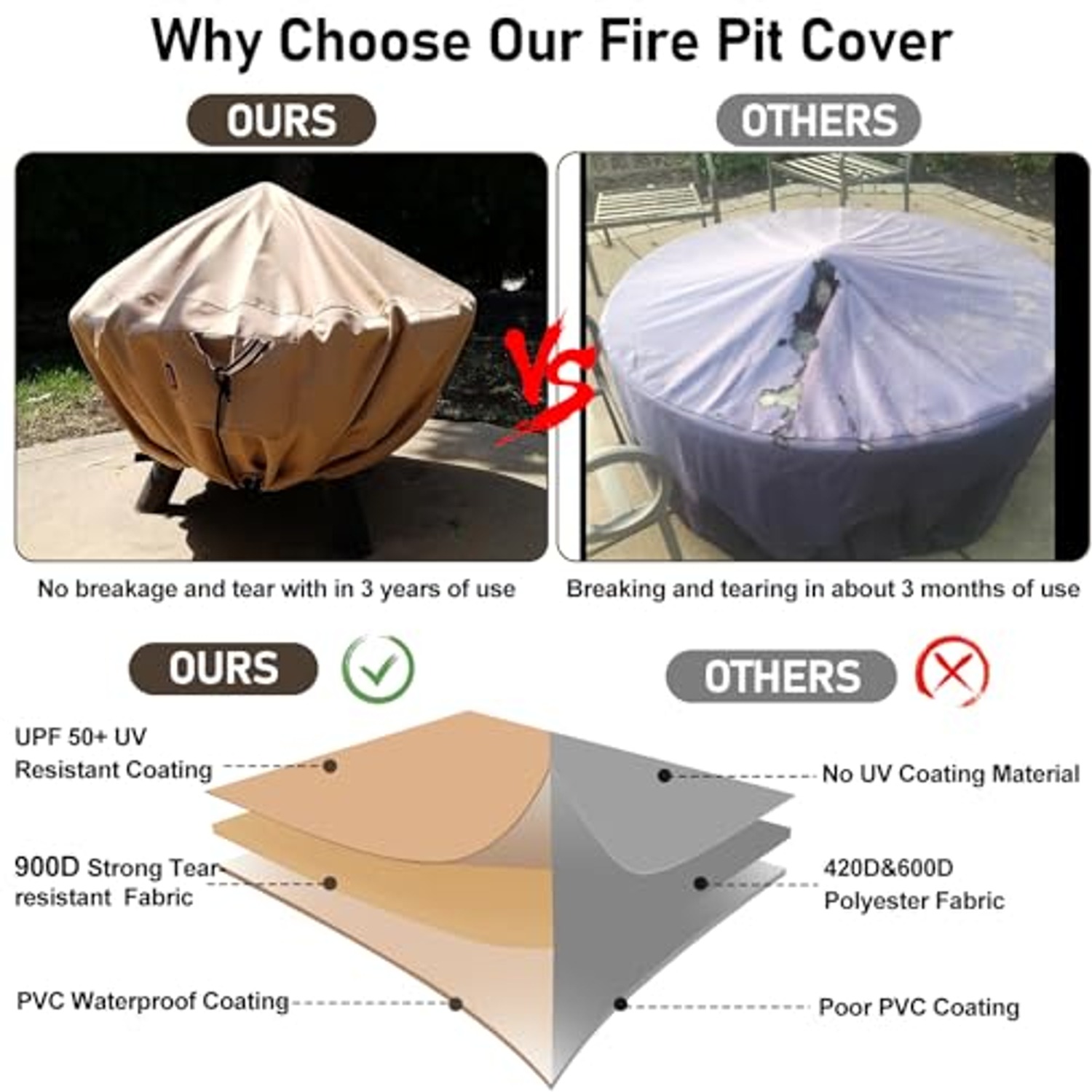
Most inexpensive covers land at 210D or 420D. They work for a season, sometimes two, then start to split at a corner or go papery after a hard winter. At 900D, the weave is considerably heavier. It takes a knock from a chair arm or a brush past a brick edge without tearing, and it holds its shape rather than sagging into a bag.
Weight is a fair proxy for quality here, though not the only one. A thin fabric with a good coating can outlast a thick one with a bad coating. The best heavy duty fire pit cover options get both right.
How the waterproofing works
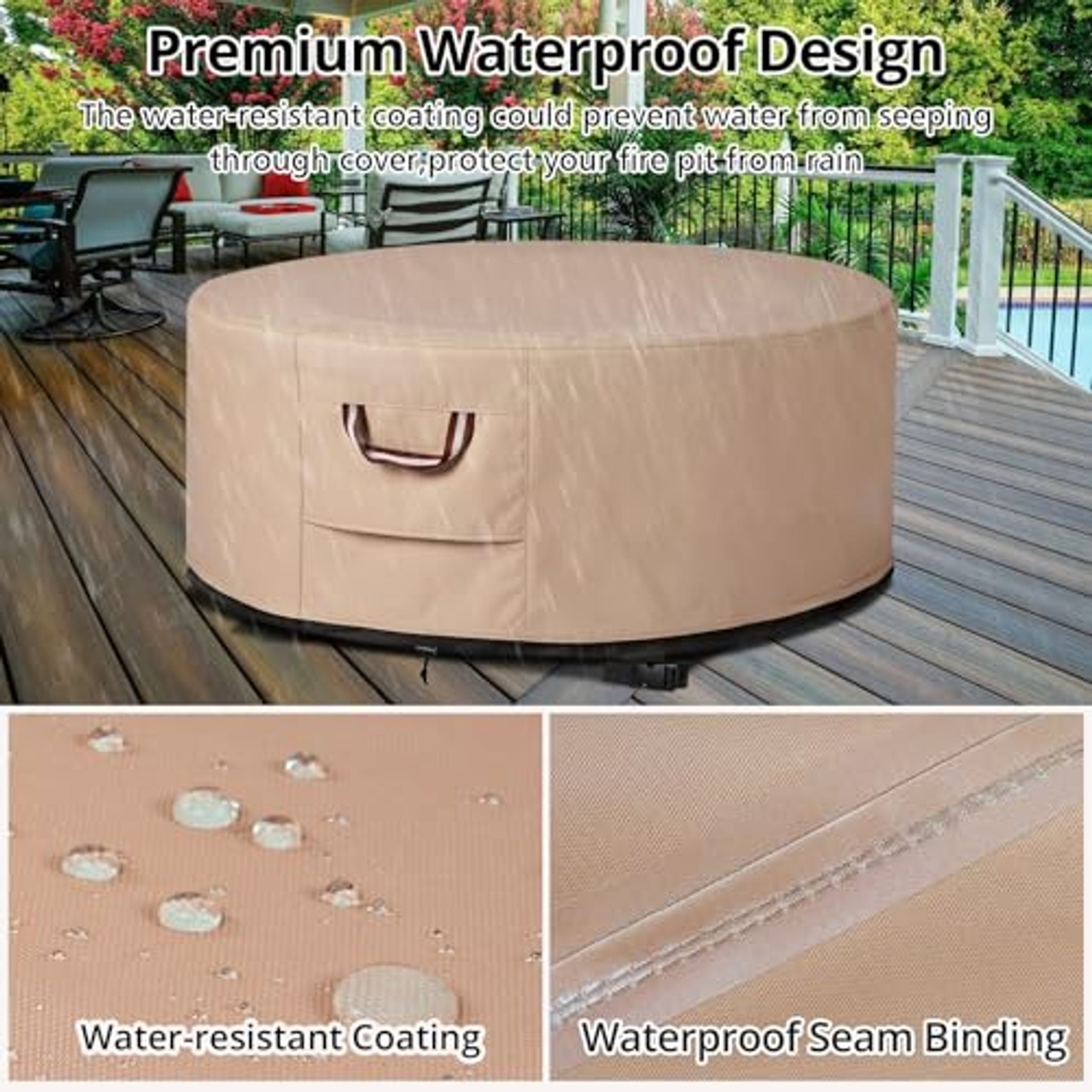
There are three parts to keeping water out, and a lot of covers only get one of them right.
First is the base fabric and its coating. Here that is waterproof vinyl with a PVC layer, which stops water passing through the weave itself. Second is the seam treatment. Every stitch is a hole, and a cover with untaped seams will drip along every join no matter how good the fabric is. This one uses heat-sealed waterproof tape over the seams, which is the step budget covers skip because it adds cost.
Third, and this is the counterintuitive one, is ventilation. A fully sealed cover traps warm moist air underneath. That air condenses on cool metal overnight and you end up with water inside the cover even though none got in from outside. Vents let that air move. If you are comparing a few options for the best waterproof fire pit cover, check that vents are part of the design, not just the coating spec.
Staying put in wind
A cover that blows off in the first storm is not protecting anything. Fit is what solves this, and there are two parts to it on this model.
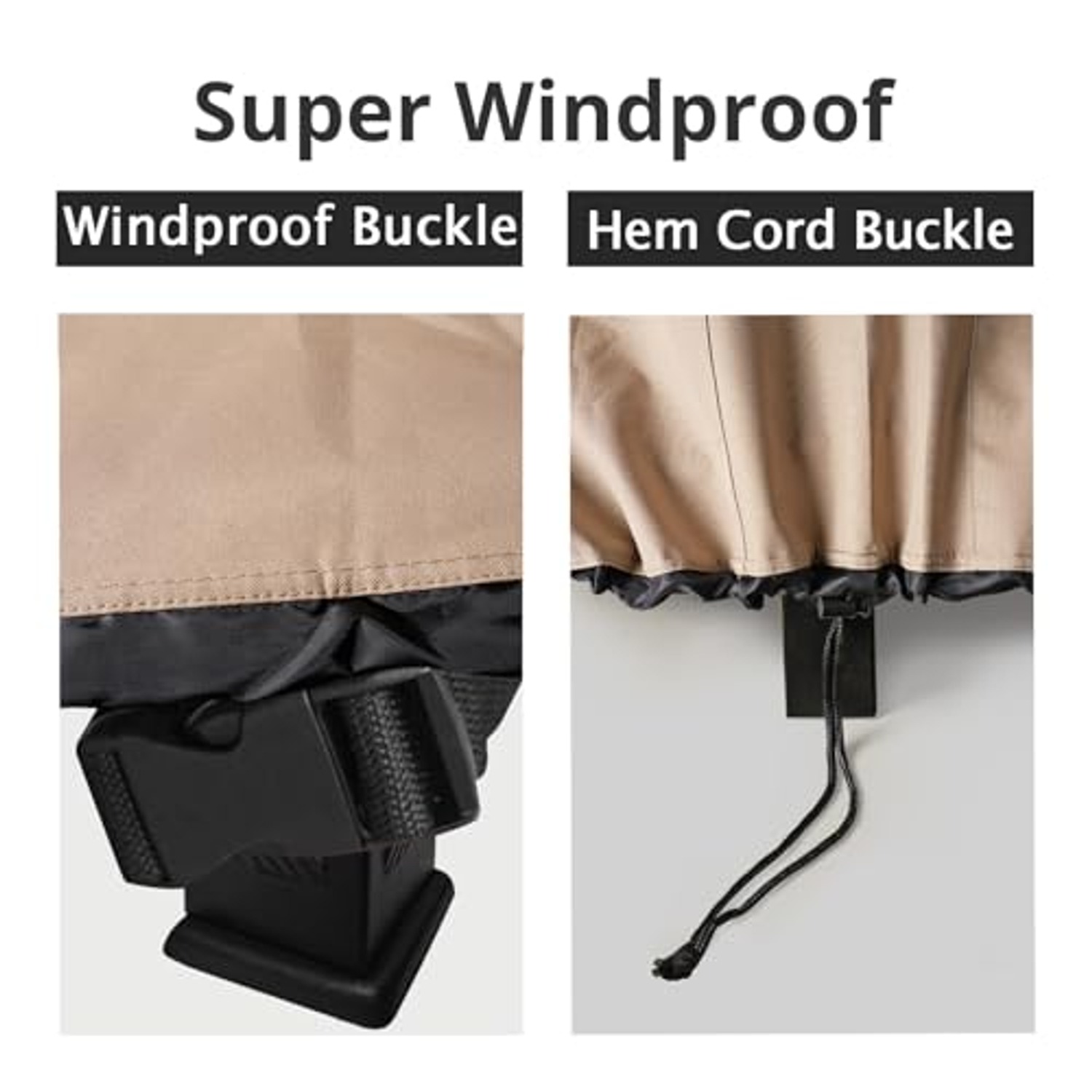
The hem has an adjustable drawstring. You pull it tight and the bottom edge draws in underneath the rim of the pit, so the cover grips rather than hangs. Then there are windproof buckles that clip to lock that tension in place, so the cord does not slowly work loose over a week of gusts.
Set up properly, the cover sits like a fitted sheet rather than a sheet thrown over a chair. That is the whole trick. Loose fabric catches air, inflates, and eventually lifts. Tight fabric has nothing to grab.
Sun, and why color fastness matters
UV does more damage to outdoor fabric than rain does. It breaks down fibers, chalks coatings, and bleaches color until the cover looks tired long before it stops working.
This fabric is rated UPF50+ and is woven from original color yarn rather than dyed afterwards. Solution-dyed fabric has the pigment locked into the fiber itself, so when the surface weathers there is still color underneath. Post-dyed fabric fades from the outside in and goes patchy. For anyone in a sunny climate, that difference is worth more than the denier number.
Who this suits
If you own a round fire pit or fire pit table in the 45 to 48 in range and it lives outside, this is aimed squarely at you. That includes gas fire pit tables, propane bowls, and wood burning pits of that diameter.
It suits people in wet climates for obvious reasons. It also suits people in hot dry ones, where dust, pollen and sun are the real enemies. And it suits anyone who uses their pit occasionally rather than constantly, because an unused pit sitting open is the one that fills with debris.
It is not the right pick if your pit is square, rectangular, significantly smaller, or has an attached tank housing that sticks out past the main footprint. Shape and size matter more than any other factor when choosing an outdoor fire pit table cover.
How to measure before you buy
Take a tape and run it across the top of the pit at its widest point, edge to edge. If there is a stone lip or a metal rim that overhangs, include it. That number is your diameter.
Then measure from the ground to the highest point of the pit. That is your height.
Compare both to the 45 to 48 in diameter and 23 to 25 in height range. If your diameter is in range but your height is a little under, you are fine, the extra fabric tucks in with the drawstring. If your diameter is over 48 in, size up. A cover that will not close is no cover at all.
Looking after it
Care is simple and mostly about habit.
Wipe the cover with a damp cloth and mild soapy water when it gets grubby, rinse it off, and let it dry fully in the open before folding. Do not machine wash it, do not tumble dry it, and keep bleach and solvents away from the coating.
Always let the fire pit cool completely before covering. Hours, not minutes, and overnight for a wood fire. Covering warm metal traps steam and is hard on both the fabric and the pit.
After heavy rain or snow, push the water or snow off the top rather than leaving it to sit. Standing weight is the main thing that stretches fabric and stresses seams over time.
When you put the cover away for the season, make sure it is bone dry first. Folding a damp cover into a dark box is how mildew starts.
The short version
A fire pit is an outdoor appliance, and outdoor appliances need protecting. This cover is sized for round pits 45 to 48 in across and 23 to 25 in high, stands 24 in tall for proper side coverage, and is built from 900D Oxford polyester with a PVC coating, taped seams, vents, a drawstring hem and windproof buckles.
Measure first, cover only when the pit is cold, keep snow and pooled water off the top, and dry it before storage. Do that and the pit underneath should still light cleanly in year five.